5/20/2025

HERE'S WHY POPE LEO X1V SHOULD REMOVE MARTIN LUTHER'S EXCOMMUNICATION

Martin Luther Defends Himself at the Diet of Worms

I wish Pope Leo the XIV well as he takes leadership of the Roman Catholic Church. In his opening speeches he has emphasized freedom and peace. In a speech to members of the press at the Vatican, he emphasized the “importance of the 'freedom of expression' and the press” and concluded by saying, “Let us disarm communication of all prejudice and resentment, fanaticism and even hatred.”

I applaud those words of Pope Leo, but I would like to see him move beyond mere words to real, pragmatic action. The Roman Catholic Church has a history of silencing and shutting down those who have dared to disagree. I would, therefore, like to hear him address the harsh, un-Christian treatment of Martin Luther by the Catholic Church.

Luther was a devout Roman Catholic priest who never wanted to leave the Catholic Church, but desired to see it reformed according to the Gospel. As the Professor of Bible and Theology at the University of Wittenberg, Luther had begun to see how far the medieval Catholic Church had strayed from Jesus and the New Testament.

He began to boldly teach that Scripture is the final authority for the Christian, rather than the pope. He also taught that we are saved through faith in Christ alone apart from church appointed works and sacraments.

His teachings were interpreted as an attack on the power structure of the Roman Church, and he was ordered to cease. Convinced that he was on the side of Scripture, he refused. Pope Leo X then excommunicated him on January 3, 1521, calling him a “child of the Devil" and describing him as “a wild boar that has invaded the Lord’s vineyard.”

Since heresy was a civil crime, Luther would have been arrested had he not been protected by the powerful German prince, Frederick the Wise. Luther later agreed to defend himself before a religious court in the German city of Worms and was guaranteed that he would not be arrested to and from this court.

At the Diet of Worms, Luther faced down the highest dignitaries in the empire, both religious and civil. Pope Leo was personally represented by the highest dignitaries in the Catholic Church. The Roman emperor, Charles I, was also present. The court ordered Luther to recant his teachings, but he refused, saying,

I consider myself convicted by the testimony of Holy Scripture, which is my basis. My conscience is captive to the Word of God; thus, I cannot and will not recant anything, because acting against one's conscience is neither safe nor sound. Here I stand! God help me! Amen!"

As promised, Luther was allowed to leave the court but after brief deliberations the court affirmed Leo’s excommunication of Luther, and an order was issued for princes and magistrates to seize Luther and turn him over to the Roman authorities. Christians were ordered not to read, print or publish any of Luther’s books, but to burn them, and such occurred in many cities.

Luther did not recant because he was convinced that he was on the right side of God and history, and history has shown he was right. The late Dr. Hans Kung, the most widely read Roman Catholic theologian in the world today, also believed Luther to be on the right side of history. He wrote,

And from a historical perspective there can be no doubt that it is not Luther but Rome which bears the chief responsibility for the way in which the dispute over the right way to salvation and practical reflection on the gospel very rapidly turned into a fundamental dispute over authority in the church and the infallibility of popes (Hans Kung, Christianity: Essence, History, And Future, 538).

One thing Luther did not have was "freedom of expression." And despite all the talk of freedom and peace, Luther remains a heretic according to Catholic doctrine. And, according to Catholic doctrine, Protestant believers are not fully Christian but are “separated brethren” and Protestant churches are not true churches but mere “Christian communities.”

Pope Leo XIV could begin a real movement toward freedom and peace by removing the Catholic Church’s ban of Luther and his designation as a heretic. This would not resolve all the issues, but it would certainly be seen as a sincere gesture of peace by the hundreds of millions of Protestant Christians around the world, including myself, who are convinced that Luther was on the right side of God and history.

Dr. Eddie L. Hyatt is a historian, Bible teacher, and revivalist. This article was derived from his books Apostolic Leadership:Returning to the Servant Leadership of Jesus and Early Christianity and The Charismatic Luther, both available from Amazon and his website at www.eddiehyatt.com.

5/10/2025

A ROMANIZED EXPRESSION OF CHRISTIANITY?

Tracing the Roots of the Pomp and Ceremony
Surrounding the Choosing of a New Pope

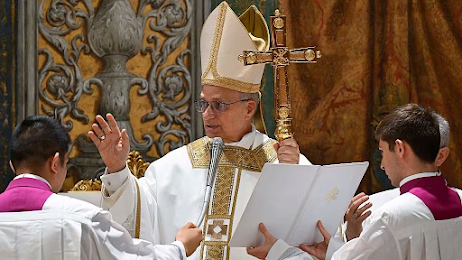
The world seemed mesmerized with the magnificent pomp and ceremony surrounding the announcement of Cardinal Robert Prevost as the next pope. In the excitement of it all, Catholic news journalists found themselves declaring religious dogma rather than objectively reporting the news. One Fox News reporter, for example, could not contain his excitement, and gushed forth calling the new pope, “the direct descendant of Saint Peter.”

There is, of course, no biblical basis for such pomp and ceremony, nor for the pope being the successor of Peter. Jesus spoke against the use of special outward clothing and titles for self-promotion. He warned Peter and the other apostles,

But you, do not be called “Rabbi”: for One is your teacher, the Christ, and you are all brethren. Do not call anyone on earth your “father;” for One is your Father, He who is in heaven. And do not be called “teachers;” for One is your Teacher, the Christ. But he who is greatest among you shall be your servant (Matthew 23:8-11).

In the New Testament, we find no sign of hierarchy in the leadership of the church. Words that carried connotations of authority such as archon (ruler), timē (rank), and despot (master) are used of Jewish and secular rulers but are glaringly missing in regard to Christian leaders.

Instead, the word diakonos is used for Christian leaders and it is a word that means “servant” and carries no connotations of status, rank or authority. This means that the pomp and pageantry of the modern Roman Catholic Church cannot be traced to Jesus and the New Testament, but to Constantine and imperial Rome.

The Source of the Pomp and Pageantry Surrounding the Pope

When the Roman emperor, Constantine, converted to Christianity in 312, he began bestowing special favors on the Christians. He built magnificent buildings for their gatherings and made elevated throne-like seating for the bishops. He also began funding the salaries of the bishops. The church obviously had an impact on the emperor, but the emperor seems to have had an even greater impact on the church.

Constantine convened, at government expense, a church council that became known as the Council of Nicaea. Although he had not been baptized, Constantine opened this council and intervened in the discussions of the bishops at certain points. The most widely read Roman Catholic theologian in the world today, the late Dr. Hans Kung, wrote,

Constantine used this first council not least to adapt the church organization to the state organization. The church provinces were to correspond to the imperial provinces, each with a metropolitan and a provincial synod. In other words, the empire now had its imperial church (Hyatt, Apostolic Leadership, 50-51).

This was the Romanizing of Christianity. The bishop of Rome now had special status afforded to him by the emperor. This status would be greatly increased when, in 330, Constantine moved the capital of the empire from Rome to the town of Byzantine located in present day Turkey. Constantine renamed the town Constantinople, after himself. It is today known as Istanbul.

The power vacuum left in Rome by the removal of all the governmental apparatus from Rome to Byzantine was filled by the bishop of Rome who began to make his claim that he was the successor of Peter, the prince of the apostles, and the head of all Christendom.

The Fabled “Donation of Constantine”

In the eighth century a fable began to be used by the popes and the Roman Church that supported and enhanced those claims. This fable, known as “The Donation of Constantine,” is now recognized as a myth by both Catholic and Protestant historians. Nonetheless, it served its purpose in infusing the papacy with imperial pomp and authority.

 According to this fable, Constantine, the persecutor of Christians, was smitten with leprosy and then healed by Pope Silvester who also converted him and baptized him. When Constantine later decided to move the capital to Constantinople without papal approval, he soon realized his sin and came and prostrated himself before Pope Silvester. When his sin was forgiven, he then moved the capital to Constantinople with the pope’s consent.

According to this myth, before departing, Constantine bestowed on Silvester the right to wear the Roman imperial insignia and robes and bequeathed to him Rome and all the provinces and cities in Italy and the western regions. In other words, Constantine bestowed on the Roman bishop a kingly royalty and authority like that of an emperor over all the cities and churches of the West.

Popes latched on to this fable and it became the basis for the papal throne and the pope’s royal insignia, garments, entourage and crown. It became the basis for popes exercising civil as well as spiritual authority.

In addition, the story implied that Constantine had received his authority for establishing the Byzantine empire of the East from the bishop of Rome. This was used by later popes to claim universal authority over all churches everywhere, even those of Byzantine.

Found to be False

It was not until the 15th century that this story was challenged by the Catholic official and historian, Lorenzo Valla. The Donation of Constantine is now widely recognized, even by Catholic historians, as fictitious. Nonetheless, it served its purpose in providing a powerful argument for the medieval popes to further their claims of universal preeminence and authority.

Indeed, after Constantine, the Romanizing of the church continued, leading the historian, Rudolph Sohm, to say, “The constitution of the Church was, in the main, modeled on the  organization of the Empire.” And the late Cardinal Leon Joseph Suenens admitted,

When I was young the Church was presented to us as a hierarchical society: it was described as “juridically perfect,” having within itself all the powers necessary to insure and promote its own existence. This view reflected an image of the Church which was closely modeled on civil, and even military, society (Hyatt, Infallible Pope: Key to Unity or Source of Division, 29).

After Constantine, the bishops were generally looked upon as the successors of the apostles and the bishop of Rome as the successor of Peter, the chief of the apostles. They began dressing in imperial regalia, surrounded by Romish pomp and ceremony. This was based, not on Scripture, but on Roman imperial custom and law. Kung has commented on this, saying,

Bishops were accorded secular titles, insignia and privileges which up to then had been reserved for the emperor or high officials: candles, incense, a throne, shoes, the maniple, the pallium and so on (Hyatt, Apostolic Leadership, 49-50).

So, the grandiose ritual and ceremony that we have observed in the choosing of a new pope is clearly rooted in ancient, imperial Rome, not in Jesus and the New Testament.

Consider Ourselves

But before we become too critical, we must come down off our own religious thrones and consider to what degree we have been impacted by modern culture. To what degree are we preaching an “Americanized” Gospel that has more in common with Hollywood and Wall Street than with Jesus and the New Testament?

There is plenty of room for repentance in Protestantism as well as Catholicism. Let us, therefore, pray for the new pope and pray that during the next decade there will be a return to Jesus and the New Testament throughout the universal church. We have the promise of Joel 2:28, repeated by Peter in Acts 2:17,

And it shall come to pass in the last days,” says God, that I will pour out of My Spirit on all flesh; your sons and your daughters shall prophesy, your young men shall see visions, your old men shall dream dreams, and on My menservants and on My maidservants I will pour out of My Spirit in those days, and they shall prophesy.

Dr. Eddie L. Hyatt is a Bible teacher, historian, and revivalist. This article was derived from two of his books, Apostolic Leadership and Infallible Pope: Key to Unity or Source of Division. Both are available from Amazon and his website at www.eddiehyatt.com.

4/17/2025

LIVING ON THE RESURRECTION SIDE OF THE CROSS


Throughout history the Church has emphasized the passion, the sufferings, and the death of Christ on the Cross, and thus highlighting the sufferings and sorrow of earthly existence. This is well and good, but we must not park there. There is the other side of the Cross—the Resurrection side—that we must embrace and live in.

On the suffering side of the Cross, the disciples of Jesus, as depicted in the Gospels, are dull, fearful, and selfish, even arguing over who will be the greatest in the kingdom. On the Resurrection side of the Cross, as depicted in Acts, everything has changed. They are now alive, insightful, and fearless as they proclaim the Good News of Jesus and His Resurrection. They are living on the Resurrection side of the Cross.

I have preached the funerals of my father, my mother, and two brothers. In each case, I experienced, not just a sense of comfort, but a sense of jubilant triumph because of the Resurrection of Jesus. Living on the Resurrection side of the Cross makes all the difference in the world when facing death.

Living on the Resurrection side of the Cross also makes all the difference when facing devastating situations in life. In the early days of our marriage and ministry, Sue and I lost everything, including a place to live. A God-given vision and ministry seemed to have died.

One day, however, as we prayed, the Holy Spirit rose up in me and began praying through me in tongues. I could actually feel His presence flowing up from my spirit and out through my mouth. All the time this was happening I was hearing these words, “Don’t be afraid of death because I Am the Resurrection.”

I immediately recalled that these were the words Jesus spoke to Martha at the tomb of Lazarus after He had said to her, “Your brother will live again.” Martha had replied, “I know He will live again in the resurrection at the last day.” Jesus then said, “I Am the Resurrection” and proceeded to raise Lazarus from the dead (John 11:23-25).

Through this encounter, God was calling me to live on the Resurrection side of the Cross. I also realized for the first time that the Resurrection is more than just a past or future event. The Resurrection has been personified in the person of Jesus Christ. Our resurrected Lord is now living in His people through the person and power of the Holy Spirit.

After the above experience, we listened, persevered, and took a step of faith. A Catholic brother whom we had never met was sent our way and made a building available to us. We opened the doors, and a powerful revival broke out. The building quickly filled to capacity with standing room only. Out of death, Resurrection life had burst forth!

The New Testament Church knew nothing of an Easter Sunday. They did not celebrate the Resurrection of Jesus once per year. Read Acts! They were consumed with the reality that Jesus was alive and His Resurrection was the center of their life and the daily focus of their witness and preaching. They lived on the Resurrection side of the Cross.

I pray that this Resurrection season the modern Church will experience a renewed vision of the significance and magnitude of Christ’s Resurrection. I pray that once again the people of God will live on the Resurrection side of the Cross.

Dr. Eddie Hyatt is an author, revivalist, Bible teacher, and church historian. This article is derived from his books, Discovering the Real Jesus and Why I Believe in God, both available from amazon and his website at www.eddiehyatt.com.   
 

4/16/2025

WHAT WE CAN LEARN ABOUT EFFECTIVE SPIRITUAL WARFARE FROM CHARLIE KIRK AND PAUL

In my opinion, Charlie Kirk is the most effective practitioner of spiritual warfare in America today. He utilizes an approach that is almost absent from the modern church but is clearly laid out by Paul in his 2nd letter to the Corinthians. It is also the method Paul used with great success in the pagan, idolatrous city of Ephesus.

This approach to spiritual warfare amounts to what I call “dismantling false belief systems.” This approach is clearly delineated by Paul in II Corinthians 10:4-5 where he says,

For the weapons of our warfare are not carnal but are mighty through God to the pulling down of strongholds, casting down imaginations and every high thing that exalts itself against the knowledge of God . . ..

False Belief Systems Must be Dismantled

The English word “imaginations” in this passage is a poor translation of the Greek word logismous, which refers to a way of thinking or a belief system. This is why the NKJV and NIV translate the word as “arguments” and Thayer’s Greek English Lexicon defines it as “reasonings such as are hostile to the Christian faith.”

The Greek word for “casting down” is kathairesin and is a very intense word. It means to “take down” or “demolish” or “dismantle.”

Paul is here saying that we are to dismantle those false belief systems by which Satan holds people, cities, churches, and nations in bondage. We have a model of how this can happen in Luke’s account of Paul’s ministry in the pagan, idolatrous city of Ephesus

Paul’s Modus Operandi in Ephesus

Ephesus was a very idolatrous and occultic city. It was home of the massive and ornate temple of the famous mother goddess, called Diana by the Romans and Artemis by the Greeks. Luke says that Paul, during his time in Ephesus, spent two years reasoning daily in a public lecture hall known as the school of Tyrannus (Acts 19:9-10). This was his approach to spiritual warfare in Ephesus.

The word “reasoning” in this passage is from the Greek word dialegomenos and it means to “dialogue” or “reason.” This indicates that Paul gave time and space for people to comment, challenge and ask questions about his message. He did this because he knew that if there was to be ultimate change in their lives, he would have to dismantle their present belief system or way of thinking.

Paul was aware that Satan has no real power for he suffered absolute and total defeat through the cross, resurrection and ascension of Jesus. Satan’s only power is in lies and deceptions. That is why Jesus referred to Satan as a liar and the father of lies (John 8:44b) and Revelation 12:9 refers to him as, that serpent of old, the Devil and Satan, who deceives the whole world

Paul would have been aware of the words of Jesus in John 8:32, You shall know the truth and the truth shall make your freeThis is why he would dialogue with these pagans for hours per day, every day. It was not enough to preach a feel-good sermon and have those interested to repeat a prayer and fill out a card. They must be given a whole new way of thinking. By dismantling their false belief systems, Satan would no longer be able to hold them in bondage.

His method worked for eventually people began bringing their books of sorcery and magic, piled them up and burned them publicly. Luke says the cost of the books was 50,000 pieces of silver, an enormous sum of money, which shows the dramatic change taking place in their thinking.

The economy, which was based on the tourism related to the temple of Diana, also began to collapse. This all happened because Paul spent two years dismantling their false belief systems.

Charlie Kirk’s Approach is Like Paul’s

Charlie Kirk, founder of Turning Point USA (TPUSA) goes to university campuses, not to entertain or to be liked by the students, but to dialogue with them and challenge their worldview. His approach is like Paul’s in Ephesus and is very effective. In fact, he is credited with turning the youth vote to Donald Trump and helping put him in the White House.

Charlie is a devout follower of Jesus and is not shy about defending his faith but does not go to a university campus to preach a sermon. With the university’s permission, he will set up a sound system in the open air with his own microphone and a microphone for the audience. He then invites students to make their case for transgenderism, atheism, support for Hamas, hatred for Trump, etc.  

With thousands of students gathered, the dialogue begins. He listens but politely interjects, challenges, and dismantles their false belief system in front of the other students. The results are amazing and similar to the results of Paul’s dialogues in Ephesus. With false belief systems being dismantled, Satan is losing his hold on the younger generation.

Thousands are now attending these dialogues on secular campuses and TPUSA chapters are springing up on campuses across the land. Politically liberal students are becoming conservative and Christian students are getting what many never got from their local churches—a rational belief system that equips them to defend their Christian worldview.

The results remind us of those described by Luke concerning Paul’s daily dialogues in Ephesus. He wrote, And this continued for two years, so that all of Asia heard the word of the Lord Jesus, both Jews and Greeks (Acts 19:10).

The Lesson for the Modern Church

The lesson for the modern churches is that we must be more than entertainment centers. There is a place for good Christian entertainment, but we will not hold the youth by merely entertaining them. We must be about the business of making disciples and preparing them to dismantle the false belief systems that Satan is using to hold the masses in his grasp.  

In other words, this is no time for a consumer-friendly approach. This is no time to be overly concerned about offending people and being “liked” by contemporary culture. It's time for Christians in America, and the world, to rise up, take the truth of God’s word, and dismantle the false belief systems that Satan using to hold this generation in his grasp.

Dr. Eddie Hyatt is the founder of the "1726 Project" and the author of numerous books on Biblical issues and revival history, including his book, 1726, which documents how the First Great Awakening gave birth to America and ignited an Abolition movement that eventually brought about the end of slavery. These books are available from Amazon and his website at www.eddiehyatt.com.

WHY AMERICA'S FOUNDERS WOULD BE APPALLED AT JUDGE BOASBERG'S GRAB FOR POWER

On Wednesday, Federal District Judge, James Boasberg, continued his unprecedented grab for power by ruling that “probable cause exists” to hold Trump administration officials in “criminal contempt” for violating his orders in mid-March to halt the deportation of Venezuelan gang members to El Salvador.

Steve Vladeck, a professor at the University of Georgetown School of Law, admitted that such a move is odd, saying, “Holding federal executive branch officials in criminal contempt is just about unheard of.”

America’s founding generation would be stunned by such a grab for power by an unelected individual. They all harbored a deep mistrust of human nature and feared governmental power falling into the wrong hands. In the most popular book of that era, Common Sense, the author, Thomas Paine, wrote, “Government, even in its best state, is but a necessary evil; in its worst state, an intolerable one.”

The Biblical Basis of the American Republic
"Fallen Humanity Cannot be Trusted with Power"

America's Founders would all agree with C. S. Lewis who said, “Mankind is so fallen that no man can be trusted with unchecked power over his fellows." Because they believed human nature to be flawed because of original sin, they formed a government that would keep power out of the hands of any one person or group of persons. 

Whereas modern liberalism claims that human nature is essentially good and that people only need a change of environment and circumstances to improve their behavior, the Founders held no such utopian view of the human condition. "Take mankind in general," said Alexander Hamilton, "they are vicious." James Madison added, "If men were angels, no government would be necessary."

The historian, Benjamin Hart, wrote, "A central assumption of America's Founders was original sin, meaning the corruption of man's character." (Hyatt, America's Revival Heritage, Second Edition, 95). They, therefore, divided the powers of government into three branches: the legislative, the executive, and the judicial.

As another check on power, the Founders, in Section 1, Article 9 of the Constitution, forbade the government from issuing honorific titles of nobility and they forbade any government employee from receiving such a title from a foreign state apart from an act of Congress. In Section 10, they forbade the states from issuing honorific titles of nobility. 

In other words, they outlawed aristocracy in America. The Founders would all agree with Sir John Dalberg-Acton who said, “Power corrupts, and absolute power corrupts absolutely.” 

Power Resides with the People

The Founders envisioned a government wherein power resides with the people, not a king, an aristocracy, or unelected judges. This is why the U.S. Constitution begins with the words, “We the people . . ..” Abraham Lincoln described America’s government as being “of the people, by the people and for the people.”

Since power is to reside with the people, laws are to be passed by the representatives of the people in Congress—the legislative branch. The president—the executive branch—is to execute and enforce those laws passed by the representatives of the people. Judges—the judiciary branch—are to interpret and apply those same laws to individual cases that come before them.

District judgeships are not in the Constitution. They were created by Congress to take the load off the Supreme Court by dealing with cases in their district. Judges were never meant to make rulings that apply across the board to the entire country. However, that is exactly what is happening as unelected judges legislate from the bench and overturn the will of “we the people.” 

Donald Trump was elected by the people of the United States, and the president is the only government official elected by all the people. If successful, the the actions of Judge Boasberg would completely undermine the American system of government wherein power lies with "we the people."

The Way Forward from Here

Jesus clearly taught that leadership is to be characterized by humble service, not pompous power, and America's Founders wholeheartedly agreed. This is why George Washington exhorted the governors of the various states to pattern their lives after Jesus (Hyatt, 1726: The Year that Defined America, 120).

This is why Washington and all the Founders would be appalled at an unelected official's arrogant reach for power over the president and executive branch. Their view of leadership was based on Christian teachings, which eschews such pursuits of power. This is why Dr. Michael Novak wrote,

Far from having a hostility toward religion, the Founders counted on religion [Christianity] for the underlying philosophy of the republic, its supporting ethic, and its reliable source of rejuvenation (Hyatt, 1726: The Year that Defined America, 171).

This is a critical moment in time when we, as the church, must be about our primary calling of being “salt” and “light” to this generation, calling the nation back to God, rebuking the ungodly pursuits of power, and directing the people to pray and expect another Great Awakening to revive and renew the church and the nation.


This article was derived from the books 1726: The Year that Defined America and America's Revival Heritage (Second Edition) by Eddie L. Hyatt and available from Amazon and his website at www.eddiehyatt.com

4/14/2025

HOLY WEEK - CONSUMED BY HOLY FIRE

This is “Holy Week” on the Christian calendar--the time between Palm Sunday when Jesus rode into Jerusalem on a donkey, and Easter Sunday when He arose from the dead after being crucified. That first Holy Week was a very tumultuous time when passions burned white hot in both Jesus and His opponents. 

During that week, we see in Jesus the Biblical truth that God experiences the full range of emotions that humans feel. Throughout Scripture, He expresses love, compassion, sadness, and anger. Jesus, however, is never controlled by emotion. The white-hot emotions we see in Jesus during Holy Week express the seriousness of His mission and the serious consequences for those who reject Him. 

Jesus Weeps in Love at the Plight of Jerusalem

For example, as Jesus neared the city of Jerusalem and and it came into view from the Mount of Olives, He began to weep and lament with great sadness. His sadness was rooted in His love for this beloved city of David, the center of Judaism, where so many prophets had prophesied. His heart was broken because He  knew the city was going to reject Him--their long-awaited Messiah--and suffer dire consequences. As the tears flow freely, He laments, saying,

If you had known, even you, especially in this your day the things that make for your peace! But now they are hidden from your eyes. For days will come upon you when your enemies build an embankment around you, surround you and close you in on every side, and level you and your children within you to the ground . . . because you did not know the time of your visitation (Luke 19:41-44)

Later in this same week, He laments again, crying out, "O Jerusalem, Jerusalem, the one who kills the prophets and stones those who are sent to her! How often I wanted to gather your children together as a hen gathers her chicks under her wings but you were not willing. See! Your house is left to you desolate."

What Jesus prophesied took place around 40 years later when the Roman general, Titus, led an army to the city to put down a revolt that had arisen against Roman rule. The Romans built an embankment, as Jesus predicted, laid siege to the city and eventually broke through the walls. They razed and destroyed both the city and the temple. Tens of thousands were killed, enslaved, and executed.

No wonder Jesus wept! His sadness, however, was soon turned to anger as He entered the city and observed how the temple worship had been turned into a money-making racket.

Temple Worship Turned into a Money-Making Racket

The temple of Jesus’ day had become a center of unethical business practices and underhanded dealings. Because Jewish pilgrims who came to worship at the temple needed animals for sacrifices, local businessmen with $$$ in their eyes had set up shop selling the required lambs, goats, doves, etc. that the Law required. However, they were charging exorbitant prices for these sacrificial animals and getting rich off their sales.

Also, since purchases and offerings at the temple could not be made with foreign coins with pagan images, other entrepreneurs with similar monetary motives had set up shop and were ripping off foreign worshippers of the Diaspora by charging exorbitant exchange rates for the Hebrew shekel.

The religious leaders, who oversaw the temple worship, were getting their cut of this flow of tainted money. It was a repulsive and nauseating situation.

This made Jesus Angry

Jesus’ anger burned white hot as He observed this monetary racket, and He began to take action. The unreal picture of a “nice” Jesus who would never oppose or condemn anyone dissolves before our eyes in this stunning Gospel account.

With a whip in His hand and eyes blazing, Jesus entered the temple area and began turning over the tables of the moneychangers and the seats of those who sold sacrificial offerings. He drove them all out of the temple and shouted, It is written, “My house shall be called a house of prayer,” but you have made it a den of thieves (Matthew 21:13).

I am here reminded of a startling statement made by Rios Mont, former president of Guatemala, that should concern every Christian in America. Looking on as an outside observer, he warned,

The Romans made a good religion out of Christianity. The Germans made a good theology out of Christianity. Americans have made a good business out of Christianity.

Consumed by Holy Fire Brings Holy Awakenings

As the disciples observed this display of holy anger in Jesus, they were reminded of Psalm 69:9, which reads, Passion for your house has consumed me, and the insults of those who insult you have fallen on me.

Sharon Daugherty, co-founder of Victory Christian Center in Tulsa, OK, wrote a powerful song about such holy passion and fire. The chorus says,

Consumed by the cry of Your Spirit,

Consumed by Your calling on me.

May my life forever be,

Consumed by Your fire in me.

After Jesus cleansed the temple of its unholy practices, something marvelous happened. Matthew 21:14 says, Then the blind and lame came to Him in the temple and He healed them. As healings and miracles began to occur, shouts of praise began breaking forth. Even small children were overcome with what they were seeing and began crying out, “Hosanna to the Son of David.”

I pray that during this Holy Week there will a remnant of God’s people who will be consumed anew with a burning, holy passion for His house, His Message, His plan and His purpose. Something marvelous will happen. We too will see miracles like we have never seen and spontaneous shouts of praise breaking forth from people everywhere.

This article was derived in part from Dr. Eddie Hyatt’s books, Discovering the Real Jesus and Why I Believe in God, available from Amazon and his website at www.eddiehyatt.com. He is the founder of the “1726 Project” whose purpose is to educate the American populace about the role of the First Great Awakening in the founding of America.

4/04/2025

WHY THE CHURCH MUST DISMANTLE THE FALSE BELIEF SYSTEMS OF THIS GENERATION

I recently sat with a small group in a circle that included Rafael Cruz, the father of TX Senator Ted Cruz, and his niece, Bibi Loyola, who is Ted’s cousin and grassroots coordinator. We were having an informal interactive Bible study and the conversation turned to the role of politics in changing American culture.

I suggested that it will take more than politics and an election to change America. Everyone heartily agreed and Rafael pointed out that the church in America needs to understand spiritual warfare, and he quoted II Corinthians 10:4-5, which reads,

For the weapons of our warfare are not carnal but are mighty through God to the pulling down of strongholds, casting down imaginations and every high thing that exalts itself against the knowledge of God . . ..

A New Belief System is a Must

I then shared a powerful truth I discovered while studying this passage about eight years ago. I told them how the word “imaginations” is a poor translation of the Greek word logismous, which actually refers to a way of thinking or a belief system. This is why the NKJV and NIV translate the word as “arguments” and Marshall’s Greek-English Interlinear translates it as “reasonings.

The Greek word for “casting down” is kathairesin and is a very intense word. It means “to take down” or “demolish” or “dismantle.”

Paul is here saying that we are to dismantle those false belief systems by which Satan holds people, cities, churches, and nations in bondage. We have a model of how this can happen in Luke’s account of Paul’s ministry in the pagan, idolatrous city of Ephesus

Paul’s Modus Operandi in Ephesus

Ephesus was a very idolatrous and occultic city. It was home of the massive and ornate temple of the famous mother goddess, called Diana by the Romans and Artemis by the Greeks. Luke says that Paul, while in Ephesus, spent two years “reasoning daily” in a public lecture hall known as the school of Tyrannus (Acts 19:9-10).

The word “reasoning” in this passage is from the Greek word dialegomenos and it means to “dialogue” or “reason.” This indicates that Paul gave time and space for people to comment, challenge and ask questions about his message. He did this because he knew that if there was to be ultimate change in their lives, he would have to dismantle their present belief system or way of thinking.

This is why Paul would dialogue with these pagans for several hours per day, every day. It was not enough for them to come forward, repeat a prayer and fill out a card. They must be given a whole new way of thinking. By dismantling their false belief systems, Satan would no longer be able to hold them in bondage.

Interestingly, Luke makes no mention of Paul utilizing any of the modern, popular methods of spiritual warfare. There is no mention of Paul screaming at principalities and powers over Ephesus or casting down a Diana spirit over the city.

Paul was aware that Satan has no real power for he suffered absolute and total defeat through the cross, resurrection and ascension of Jesus. Satan’s only power is in lies and deceptions. That is why Revelation 12:9 refers to him as, that serpent of old, the Devil and Satan, who deceives the whole world.

Satan is the author of false belief systems by which he holds people, cities, and nations in bondage. Paul knew that the stronghold by which the Ephesians were held in bondage was a false belief system. Only a new way of thinking—a Biblical way of thinking—would free them from Satan’s grasp.

His method worked and before too long people began bringing their books of sorcery and magic, piled them up and burned them publicly. Luke says the books were valued at 50,000 pieces of silver, and I have seen modern estimates of anywhere from five-hundred thousand to two million dollars. In addition, the economy, which was based on the tourism related to the temple of Diana, began to collapse. This happened because Paul spent two years dismantling their false belief systems.

Today’s Church Must Dismantle the False Belief Systems of this Generation

Ever since that experience in the Bible study, it has been resonating and reverberating in my heart that the modern church must be about the business of dismantling the false belief systems of this world by which Satan holds the masses in bondage.

This is no time for a consumer-friendly approach. This is no time to be overly concerned about offending people and being “liked” by contemporary culture. We must take seriously the words of Jesus in John 8:31-32, If you continue in My word, you are My disciples indeed; and you shall know the truth and the truth shall make you free.

It's time for Christians in America, and the world, to rise up, take the truth of God’s word, and dismantle the false belief systems of this generation.

To read about America's founding within a Christian belief system, which made it possible for the nation to abolish slavery, survive a civil war, defeat Jim Crow, and become a nation that attracts millions from all over the world, read Dr. Eddie Hyatt's book, 1726: The Year that Defined America, available from amazon and his website at www.eddiehyatt.com