4/24/2018

5 PILLARS ON WHICH THE AMERICAN REPUBLIC WAS FOUNDED


America was founded on Christian principles and values. It was not founded as a theocracy. Theocratic rulers claim a Divine right to rule over their subjects. America’s founders held no such grandiose view of themselves or any human being, and they had rejected the theocratic claims of popes, priests, and monarchs. They had not, however, rejected Christianity.
America’s Founders, for the most part, identified with the mindset of those they called “dissenting Protestants.” The dissenting Protestant insisted that civil government should have no role in the church nor in matters of faith and conscience. Freedom from government tyranny in matters of faith was an ideal that pervaded the thinking of America’s Founders.
However, for there to be liberty without license, the Founders knew that the populace would have to be governed from within by virtuous values. That is why they all agreed that only Christianity provided the moral values and intellectual underpinnings for a stable and prosperous nation.
Here are 5 pillars on which the American Republic was founded.
Pillar #1
Faith in God as the Creator and Moral Governor of the Universe
The Founders considered belief in the God of the Bible as being essential for good citizenship. Unless the citizens would have a moral sense of obligation to their Creator, they would tend to live selfish, unrestrained lives, harmful to society.
This was expressed by James Madison when he wrote, “Before any man can be considered as a member of civil society, he must be considered as a subject of the Governor of the Universe.” Madison also wrote,
The belief in a God All Powerful wise and good, is so essential to the moral order of the world and to the happiness of man, that arguments which enforce it cannot be drawn from too many sources nor adapted with too much solicitude to the different characters and capacities impressed with it (Hyatt, Pilgrims and Patriots, 131).
The Founders functioned on the assumption of a Divine Creator to whom all creatures owe their love, honor, and respect, and this is made clear by the many proclamations for days of prayer, repentance and thanksgiving issued by the Congress and presidents. During the Revolutionary War no less than 15 such calls for days of prayer were issued by the Continental Congress.
After being sworn in as president, George Washington issued a proclamation designating November 26, 1789 as a Day of Thanksgiving. The proclamation assumes the obligation of all citizens to acknowledge God’s existence and to show honor to Him. It opened with the following statement.
Whereas it is the duty of all Nations to acknowledge the providence of Almighty God, to obey his will, to be grateful for his benefits, and humbly to implore his protection and favor, and whereas both Houses of Congress have by their joint Committee requested me to recommend to the People of the United States a day of public thanksgiving and prayer to be observed by acknowledging with grateful hearts the many signal favors of Almighty God . . ..
The Declaration of Independence begins by acknowledging the Creator and recognizing that all human rights come from Him. That is the basis on which John Dickinson, chairman of the committee for the Declaration of Independence, declared in 1776, “Our liberties do not come from charters for these are only the declarations of preexisting rights. They do not depend on parchment or seals; but come from the King of Kings and the Lord of all the earth.”
Indeed, although there was tolerance for those of various faiths, there was a hostility toward atheism in early America. This was born out when a judge in the court of Chester County in the state of New York, threw out the testimony of a witness when the witness admitted he did not believe in the existence of God.
The judge said it was the first time he had met someone who did not acknowledge the existence of God. He went on to say that by denying the existence of God, the witness had “destroyed all the confidence of the court in what he was about to say.”
This event was recorded by the French sociologist, Alexis de Tocqueville, and occurred during his visit to America in 1831. Tocqueville said the incident was merely noted in the newspaper without further comment.
It is no accident that monuments in Washington D.C. abound with references to God and verses of Scripture. This pervasive belief in God by America’s Founders is also reflected in the statement “In God We Trust” being emblazoned on all federal currency. It is reflected in the phrase “one nation under God” being part of the Pledge of Allegiance that is repeated by every new citizen, and once was repeated every morning by school children across America.
Yes, belief in the all-knowing, all-powerful God of the Bible—the Moral Governor of the Universe--was considered a necessity for a prosperous and stable nation by virtually all early Americans.
Pillar #2
Belief in the Bible as the Source of Ultimate Truth
When George Washington placed his hand on a Bible to take the oath of office it was no mere formality, but a declaration that the Bible would be the ultimate source of wisdom and guidance for his administration. He also once said, “It is impossible to rightly govern the world without God and the Bible” (Hyatt, Pilgrims and Patriots, 137).
A ten-year project instituted to discover where the Founders got their ideas for America’s founding documents found that by far the single most cited authority in their writings was the Bible. They were people of the Book and consciously and unconsciously used it as the standard for measuring all other writings both ancient and modern.
From the beginning, the Bible had been incorporated into all the learning of the schools in Colonial America. For example, The New England Primer coupled Bible verses and church doctrine with the learning of the ABCs. The letter “A,” for example, was associated “Adam” and the statement, “In Adam’s fall, we sinned all.” First graders in early America learned to read with the Bible!
Knowing how the Founders esteemed and reverenced the Bible, it comes as no surprise that The First Continental Congress was opened with Bible reading and prayer. It is also no surprise that when Benjamin Franklin called the Constitutional Convention to Prayer, he quoted from both the Psalms and the Gospels (Hyatt, Pilgrims and Patriots, 143-44).
While he was at The College of New Jersey, now Princeton University, James Madison translated the Bible from Hebrew and Greek into English. Dr. D. James Kennedy and Jerry Newcombe were right when they said, “Madison’s worldview was one shaped by the Bible more than any other source” (Hyatt, Pilgrims and Patriots, 146).
The Founders lived at a time when the European Enlightenment and its emphasis on reason was drawing many on the European continent away from the Bible. America’s Founders, however, saw no dichotomy between the Bible and reason. William Novak says,
Everywhere that reason led, Americans found the Bible. If they read Francis Bacon, they found the Bible. If they read Isaac Newton or John Milton, they found the Bible. In Shakespeare, they found the Bible. In the world of the founders, the Bible was an unavoidable and useful rod of measurement, a stimulus to intellectual innovation.
This primary role of the Bible in America’s founding was acknowledged by Andrew Jackson, America’s 7th president, when he said, “That book, sir, is the rock on which our Republic rests.”
Pillar #3
The Human Condition Has Been Flawed by Sin
And Cannot be Trusted with Unlimited Power.
Marxism and modern liberalism claim that human nature is essentially good, and that people only need a revolutionary change of circumstances and institutions to improve and perfect their behavior. The Founders held no such utopian view of the human condition.
They held the traditional Christian belief that humanity had been created a noble creature in the image and likeness of God, but that this image had become marred because of the fall and sin (Genesis 1-3). Because the image was not erased, humanity is capable of very noble deeds; but since the image is marred, he is also capable of very dastardly deeds.
Although modern society does not want to hear about sin, human history cannot be understood apart from it. Only the Biblical account of the entry of sin into the world provides the context for understanding the wars, genocides, inquisitions, holocausts, and cruelties that have been an ongoing part of human history down to the present time.
Yes, salvation through Jesus Christ restores the image of God in mankind, but this restoration is a process that is not completed in this world. Humanity—even Christian humanity—in this flawed condition cannot be trusted with unlimited power.
The historian, Benjamin Hart, wrote, “A central assumption of America’s founders was original sin, meaning the corruption of man’s character.” “Take mankind in general,” said Alexander Hamilton, “they are vicious.” James Madison added, “If men were angels no government would be necessary,”
Because of mankind’s corrupt nature, a government is necessary to protect the good and punish the evil. However, since corrupt human beings must administer such government they cannot be trusted with unlimited power.
It was this mistrust of human nature that influenced the Founders to divide the powers of government into three branches and to provide checks and balances to keep any individual or group from gaining unlimited power. The Founders would agree with Sir John Acton who said, “Power corrupts; absolute power corrupts absolutely.”
It is also why, in Section 9 of the Constitution, the Founders forbade the American government from granting honorific titles of nobility to anyone and forbade anyone holding a government office from accepting a title or office from a foreign king or state without the consent of Congress.
The Founders had a Biblical view of human nature and that is why they limited the powers of government and abolished aristocracy and hereditary privilege. Even then, said Washington, “We have probably had too good an opinion of human nature in forming our confederation.”
Marxism and liberalism claim that the problem with human corruption stems from corrupt institutions. The Bible teaches the opposite. It is corrupt human beings who create corrupt institutions. The Founders, therefore, not only instituted a limited government, but also counted on Christianity to provide the moral and intellectual influence necessary for a stable society, for only a virtuous people could be a truly free people.
Pillar #4
Christianity Provides the Moral and Intellectual
Underpinnings Necessary for a Stable and Prosperous Nation.
In his Farewell address after serving two terms as America’s first president, George Washington declared, “Of all the dispositions and habits which lead to political prosperity, religion [Christianity] and morality are indispensable supports.” He goes on to say that the person who would “labor to subvert these great pillars of human happiness” can never claim to be an American patriot.
Thomas Jefferson was in complete agreement and he made Washington’s Farewell Address required reading at the University of Virginia, which he had founded. And notice that Washington did not call religion optional. The word he used was “indispensable” and Jefferson obviously agreed. It should be remembered that when the Founders used the word “religion” they were referring to Christianity.
Jefferson may have had questions at times about certain aspects of Christian doctrine, but there is no question that he saw Christianity as providing the moral and intellectual system necessary for a stable society. Having read the Koran and the literature of ancient Greece, Rome, and the Enlightenment, he stated, “Of all the systems of morality that have come under my observations, none appear to me so pure as that of Jesus.”
Jefferson’s commitment to Christian values is why he closed all presidential documents with the appellation, “In the year of our Lord Christ.” It is also why he took money from the federal treasury to pay for missionaries to work among the Kaskasia Indian tribe and to build them a building in which to worship.
Washington, Jefferson and all the Founders knew that the success of the nation they had formed hinged on the moral character of its citizens and their ability to govern themselves according to Biblical values. This is why John Adams, in a 1798 address to the officers of the Massachusetts Militia, declared,
We have no government armed with power capable of contending with human passions unbridled by morality and religion . . .  Our Constitution was made only for a moral and religious [Christian] people. It is wholly inadequate to the government of any other (Hyatt, Pilgrims and Patriots, 173).
It was this emphasis on the morality of Jesus and the New Testament that eventually brought about the end of slavery in America. Walter Williams, the brilliant black professor of economics at George Mason University, points out how slavery had been practiced by many civilizations throughout human history before it was brought to America. He then says that the unique thing about slavery in America was “the moral outrage against it.”
This moral outrage was rooted in the Christian worldview that was promulgated throughout the land. Writing about the existence of slavery in his home state of Virginia in 1781, Jefferson expressed hope that it would soon be abolished and then warned,
God who gave us life, gave us liberty. And can the liberties of a nation be thought secure when we have removed their only firm basis, a conviction in the minds of the people that these liberties are a gift from God? That they are not to be violated but with His wrath? Indeed, I tremble for my country when I reflect that God is just and that His justice cannot sleep forever (Hyatt, Pilgrims andPatriots, 160-61).
The Founders did not believe that there could be liberty apart from virtue, or freedom apart from morality. Only Christianity offered the moral and intellectual underpinnings that would preserve the nation they had brought into existence. This is why Novak says, “The founders did not believe the constitutional government they were erecting could survive without Hebrew-Christian faith.”
Pillar #5
Government’s Role is to Protect Faith and Freedom
No part of the Constitution has been so mangled and misapplied as that part of the First Amendment that reads, “Congress shall make no law concerning the establishment of religion or hindering the free exercise thereof.” Secularists have wrenched this statement from its historical context and original intent and made it to mean, not freedom of religion, but freedom from religion.
In this new and novel approach to the First Amendment, atheists and agnostics are protected from being offended by anything religious. Based on this distortion, prayer and Bible reading have been banned from public schools, crosses and Ten Commandment displays have been removed from public buildings, and students have been told they cannot talk about their faith in God at graduation ceremonies.
The fact is, however, that the day after voting to ratify the First Amendment, those same Founders issued a proclamation for a day of prayer and thanksgiving. Congress continued to be opened with prayer and Bible reading and prayer continued to be a daily part of the normal school day in America. Presidents also continued to issue proclamations for special days of prayer and thanksgiving.
The First Amendment had nothing to do with secularizing America or banning faith in the public square. By implementing the First Amendment, the Founders were simply saying that America would never have a national, state church as had been the case in Europe since the time of Constantine. Indeed, it was from these oppressive state churches that their parents and grandparents had fled.
When Jefferson used the phrase “wall of separation” in a letter to a Baptist association, he was assuring them that the First Amendment guaranteed them protection from persecution by the state such as they had known in the Old World and even in Jefferson’s home state of Virginia. Jefferson saw the First Amendment as a unilateral wall erected to keep the government out of the church, not to keep the influence of the church out of government.
It is obvious to anyone who knows history that the First Amendment was not put in place to stifle Christianity or to be indifferent towards it. The words and actions of the Founders make this clear. This was also made clear by Joseph Story (1779-1845) who served as a Supreme Court justice for thirty-four years from 1811-1845. Commenting on the First Amendment, he said,
We are not to attribute this prohibition of a national religious establishment to an indifference in religion, and especially to Christianity, which none could hold in more reverence than the framers of the Constitution (Hyatt, Pilgrims and Patriots, 153).
That America’s Founders did not separate God from government was obvious to the young French sociologist, Alexis de Tocqueville, who came to America in 1831 to study her institutions. As a result of his research, he concluded that Americans had combined Christianity and civil liberty so intimately in their minds that it was impossible to make them conceive of one without the other. He said, “From the beginning, politics and religion contracted an alliance which has never been dissolved” (Hyatt, Pilgrims and Patriots, 168).
The Founders would be astonished to see how the First Amendment has been distorted by modern secularists into a weapon against religious liberty, the very thing they meant to protect. Their simple purpose was to make sure that Christianity would be protected from government intrusion and that no denomination would ever be singled out for special favors.
America as a Secular Nation is a New and Novel Idea
Yes, America was founded as a Christian nation. This is not to be equated with a theocracy where individuals claim a direct mandate from God to rule and govern a people. The Founders had rejected that sort of thinking, but they had not rejected Christianity itself, for they considered Christianity to be necessary for the nation’s success and survival.
America as a Christian nation was understood as late as 1892 as expressed in the Supreme Court ruling of “Church of the Holy Trinity vs The United States.” After reviewing thousands of historical documents, the nation’s highest Court declared,
Our laws and our institutions must necessarily be based upon and embody the teachings of The Redeemer of mankind. It is impossible that it should be otherwise; and in this sense and to this extent our civilization and our institutions are emphatically Christian . . . From the discovery of this continent to the present hour, there is a single voice making this affirmation . . . we find everywhere a clear recognition of the same truth that this is a Christian nation (Hyatt, Pilgrims and Patriots, 167)
It Only Takes a Spark to Get a Fire Going
To even the casual observer it is obvious that the pillars on which our Republic was founded are eroded and seriously damaged. Years of attacks by secularists and neglect by the church have taken their toll. Many believe they are damaged beyond repair and that the American Republic our Founders brought into existence is forever gone.
I am not so pessimistic. At critical times during our nation’s history God has intervened with national awakenings that have restored virtue to the populace and saved the nation from utter ruin. These include the Second Great Awakening (1800-1830), the Great Prayer Awakening of 1857-58, and other local, regional, and national revivals throughout her history.
These were not man-made religious events, but Divine visitations from heaven. That is what we must have today. Not a hyped religious event by a skilled crowd manipulator, but a true outpouring of the Holy Spirit as promised in Acts 2:17 and as happened in the First Great Awakening and in succeeding American awakenings.
A popular Christian camp song says, “It only takes a spark to get a fire going.” Spiritual awakenings have come when a committed few have determined to pray and be salt and light in their generation. God is now looking for a few good men and women who will be the spark to ignite the fire of another great, national, spiritual awakening and strengthen the pillars on which this nation was founded. 

This article is derived from Dr. Eddie Hyatt’s book, Pilgrims and Patriots, available from Amazon and his website at www.eddiehyatt.com. Dr. Hyatt has a passion to see another Great Awakening in America and he conducts “America Reawakening” events in which he shows how America was birthed out of a great Spiritual awakening and then calls those present to a new commitment to be salt and light and to pray for another Great Awakening in our land.

2/25/2018

IT'S TIME TO DEMOLISH THE MYTH THAT IS DESTROYING AMERICA


Workers with jack hammers recently showed up at the capital grounds in Oklahoma City and removed the Ten Commandments monument by order of a federal judge who said it violated the First Amendment. In Mississippi, a federal judge, for the same reason, ordered a high school band to remove “How Great Thou Art” from the musical repertoire they played at their school’s football games. For the same reason, a kindergartner in Florida, who bowed her head to pray over her lunch, was stopped by a school staffer and told she could not pray in school.
These attacks on religious liberty have become commonplace in modern America and they are all based on a mythical “separation of church and state,” a phrase that is not found in the U.S. Constitution. “Separation of church and state” is a contorted interpretation of the First Amendment to the Constitution, which merely says, “Congress shall make no law concerning the establishment of religion, nor hindering the free exercise thereof.”
Secularists have taken the first phrase of the First Amendment, known as the “establishment clause,” and argued that any expression of faith on state-owned property amounts to an “establishment of religion.” Based on this myth, Bible reading and prayer have been banned from public schools and numerous lawsuits are regularly filed against Christians, including a recent suit filed against Benjamin Carson related to his participation in a Bible study with other members of the president's cabinet.
George Washington Was Unacquainted with This Myth
That the secularists have created a myth with their interpretation of the “establishment clause” is obvious when we consider what happened the day after the adoption of the First Amendment. Led by George Washington, the president of the Constitutional Convention, those same Founders issued a proclamation for a Day of Prayer.
Consider also that the ink was hardly dry on the First Amendment when George Washington took the oath of office with his hand on a Bible, bringing his faith to bear upon the execution of the office of president. This was in harmony with his stated belief that, “It is impossible to rightly govern the world without God and the Bible.”
Immediately then, after being sworn in, Washington and members of Congress proceeded to St. Paul’s Chapel where they participated in a worship service. So much for a “separation of church and state.”
That Washington was unacquainted with this modern myth is also demonstrated by the fact that shortly after being sworn in as president he issued a proclamation designating November 26, 1789 as a Day of Thanksgiving wherein all citizens should offer gratitude to God for His protection, care and many blessings. The proclamation reads in part,
Whereas it is the duty of all Nations to acknowledge the providence of Almighty God, to obey his will, to be grateful for his benefits, and humbly to implore his protection and favor, and whereas both Houses of Congress have by their joint Committee requested me “to recommend to the People of the United States a day of public thanksgiving and prayer to be observed by acknowledging with grateful hearts the many signal favors of Almighty God especially by affording them an opportunity peaceably to establish a form of government for their safety and happiness . . . Given under my hand at the City of New York the third day of October in the year of our Lord 1789.
So much for a “separation of church and state” in the thinking of George Washington and the founding generation.
The Source of the Myth
The phrase “separation of church and state” is derived, nor from the Constitution, but from a letter Thomas Jefferson wrote to a group of Baptists to reassure them that they would not suffer persecution from the new American government such as they had known in the Old World and even in Jefferson’s home state of Virginia.
In this letter to the Danbury Baptist Association, Jefferson assured them that in America a “wall of separation” had been erected by the First Amendment that would protect them from government intrusion. His “wall of separation” was obviously unidirectional, put in place to keep the government out of the church, not to keep God out of the government.
Modern secularists have turned Jefferson’s statement on its head by reinterpreting his wall as a barrier to keep people of faith from influencing government. Jefferson would roll over in his grave at the distortion of his simple statement of reassurance to one of the most persecuted religious groups of that era.
In Jefferson’s mind the First Amendment provided “freedom of the church from the state,” not “freedom of the state from the church.” It is obvious that even Jefferson wanted Christian influence to predominate in the new nation.
Jefferson’s Words and Actions Deny the Myth
Jefferson’s actions clearly demonstrate that he welcomed Christian influence in the public and political arenas and that he saw no problem with the government advancing Christian causes. For example, as president, Jefferson sat on the front row of church services that were held each Sunday in one of the chambers of the House of Representatives in Washington, D.C.
At one point, displeased with the music, he ordered the Marine Band to provide music for the Sunday services, and the band members were paid with money from the federal treasury. No one protested because no one of that generation had any thought of removing God from the public life of the nation.
Jefferson’s high regard for Jesus Christ is shown by the fact that he closed all presidential documents with the appellation, “In the year of our Lord Christ.” It is also shown by his statement that, “Of all the systems of morality that have come under my observations, none appear to me so pure as that of Jesus.”
As founder of the University of Virginia, Jefferson invited the churches of all sects and denominations to establish schools of instruction adjacent to or within the precincts of the university. He wrote,
The students of the University will be free and expected to attend religious worship at the establishment of their respective sects, in the morning, and in time to meet their school at the University at its stated hour (Hyatt, Pilgrims and Patriots, 151).
The Reason for the First Amendment
It is obvious that the modern myth of a “separation of church and state” did not originate with Jefferson. Neither did this myth originate with anyone in the founding generation. This was confirmed by Joseph Story (1779-1845) who served as a Supreme Court justice for thirty-four years from 1811-1845. Commenting on the First Amendment, Story said,
We are not to attribute this prohibition of a national religious establishment to an indifference in religion, and especially to Christianity, which none could hold in more reverence than the framers of the Constitution (Hyatt, Pilgrims and Patriots, 152-53).
The First Amendment was put in place to guarantee that America would never have an official, state-sanctioned church, which had been the norm in Europe since the time of Constantine. These state-authorized churches, with the power of the government at their disposal, persecuted, imprisoned and put to death those who dared to deviate from the “official” policies of the “official” state church.
Most of the founders, or their parents or grandparents, had suffered at the hands of those state churches, both Catholic and Protestant. Benjamin Franklin, for example, tells how his grandfather, during the reign of Mary Tudor, had to read the Bible to his family in secret in order to keep from being arrested.
He did this by fastening an open Bible on the bottom and underneath the cover of a stool. With one of the children watching at the door for civil or religious authorities, he would turn the stool upside down and read the Bible to his family. In case of danger, he would quickly secure the pages and return the stool upright to its place in the corner of the room.
The danger was real for during Mary’s reign many Protestants were imprisoned and 288 were burned at the stake for their faith. The Founders were determined that such would never be the case in America.
The First Amendment was put in place to guarantee religious liberty. It guaranteed that the government would never create a national, state church and would protect the liberty of all good people of faith to live and worship according to the dictates of their conscience.
The Founders considered the First Amendment to be based on Christian values of individual freedom and religious liberty, and this was affirmed over and over in their words and actions.
The Founding Generation Would be Horrified at This Modern Myth
The Christian mindset of the Founders was affirmed in a ten-year project to discover where they got their ideas for America’s founding documents, including the First Amendment. The study found that by far the single most cited authority in their writings was the Bible (Hyatt, Pilgrims and Patriots, 163). It comes then as no surprise that John Adams, nearly four decades after the American Revolution, would declare,
The general principles on which the fathers achieved independence were . . . the general principles of Christianity. Now I will avow that I then believed, and now believe, that those general principles of Christianity are as eternal and immutable as the existence and attributes of God (Hyatt, Pilgrims and Patriots, 163-64).
John Marshall (1755-1835), who served as the second Chief Justice of the U.S. Supreme Court for thirty-four years, would be mystified by the modern idea of the “separation of church and state.” In one of his writings, Marshall clearly states what every Founder assumed; that the founding documents and institutions on which the nation was formed presuppose a commitment to Christian principles and values. He wrote,
No person, I believe, questions the importance of religion in the happiness of man, even during his existence in this world. The American population is entirely Christian, and with us Christianity and religion are identified. It would be strange, indeed, if with such a people, our institutions did not presuppose Christianity, and did not refer to it, and exhibit relations with it (Hyatt, Pilgrims and Patriots, 166).
While Chief Justice, Marshall made the Supreme Court facilities available to a local congregation for their Sunday gatherings. So, each Sunday, the singing of Christian hymns and the preaching of God’s Word could be heard ringing through the chambers of both the House of Representatives and the Supreme Court. This was neither surprising nor offensive to anyone, for it fit perfectly within the mindset of the founding generation.
A French Visitor Sees No Sign of the Myth
That America’s founders did not separate God from government was obvious to the young French sociologist, Alexis de Tocqueville, who came to America in 1831 to study her institutions. He wanted to see if he could discover the reason for America’s rapid rise to power and affluence in the world.
Arriving on the heels of the Second Great Awakening, he exclaimed, "The religious atmosphere of the country was the first thing that struck me on arrival in the United States." Tocqueville said that Americans had combined the notions of Christianity and civil liberty so intimately in their minds that it was impossible to make them conceive of one without the other. He concluded that, in America, “From the beginning, politics and religion contracted an alliance which has never been dissolved” (Hyatt, Pilgrims and Patriots, 168).
According to Tocqueville, this linking of faith with civil liberty was the reason for their passion to spread the Gospel to the American frontier where new settlements were springing up. He wrote,
I have known of societies formed by the Americans to send out ministers of the Gospel in the new Western states, to found schools and churches there, lest religion should be suffered to die away in those remote settlements, and the rising states be less fitted to enjoy free institutions than the people from whom they came. I met with New Englanders who abandoned the country in which they were born in order to lay the foundations of Christianity and of freedom on the banks of the Missouri, or in the prairies of Illinois. Thus, religious zeal is warmed in the United States by the fires of patriotism.
Tocqueville told how, while he was in America, a witness was called to testify before the court in Chester County in the state of New York. When, however, the witness admitted he did not believe in the existence of God, the judge refused to admit his testimony as evidence. According to the judge, by admitting he did not believe in the existence of God, the witness had “destroyed all the confidence of the court in what he was about to say.” Tocqueville said the incident was merely noted in the newspaper without further comment.
Tocqueville saw no “separation of church and state” in America in 1831. He in fact saw faith and freedom running parallel and producing the most prosperous and free nation the world had ever seen. To those critics in Europe who did not believe that freedom and faith could coincide in a nation, Tocqueville responded, “I can only reply that those who hold this language have never been to America.”
A Supreme Court Declaration
The merger of faith and freedom was still a part of the American mindset as recent as 1892, when in the ruling of Church of the Holy Trinity vs The United States, the United States Supreme Court declared,
Our laws and our institutions must necessarily be based upon and embody the teachings of The Redeemer of mankind. It is impossible that it should be otherwise; and in this sense and to this extent our civilization and our institutions are emphatically Christian . . . From the discovery of this continent to the present hour, there is a single voice making this affirmation . . . we find everywhere a clear recognition of the same truth that this is a Christian nation (Hyatt, Pilgrims and Patriots, 167).
This clear statement was made by the nation’s highest Court after investigating thousands of historical documents. They saw no sign of the modern myth of a “separation of church and state” as is propagated by so many in our nation today.
The Way Forward
Jesus said in John 8:32, You shall know the truth and the truth shall make you free. We must take the truth and go on the offensive. We must teach everyone—friends, children, coworkers, etc.—the truth about America’s founding and about the myth that has been foisted upon us.
As truth is proclaimed and received, students, teachers, pastors, politicians and all freedom-loving people will be liberated to stand strong in their faith, for they will realize that their faith is the source of their civil liberty. This was the understanding of the Founders and was expressed by John Adams in a letter to his cousin, Zabdiel, two weeks before the adoption of the Declaration of Independence. He wrote,
Statesmen, my dear sir, may plan and speculate for Liberty, but it is Religion [Christianity] and Morality alone, which can establish the Principles, upon which freedom can securely stand (Hyatt, Pilgrims and Patriots, 173).
God is calling American Christians to take back this nation’s heritage of faith and freedom that has been stolen in the past sixty years. This is a vital key to seeing another great, national spiritual awakening sweep across the land and a national healing as promised in II Chronicles 7:14.
This article is derived from Dr. Eddie Hyatt's book, Pilgrims and Patriots, available from Amazon and his website at www.eddiehyatt.com. Dr. Hyatt also conducts "America Reawakening" events, which consists of a PowerPoint presentation documenting how America was birthed out of prayer and spiritual awakening, and a call for Christians to rise up and believe God for another Great Awakening across the land. Information is available from his website

2/16/2018

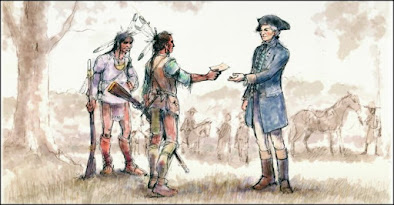
A NATIVE AMERICAN CHIEF PROPHESIES THE DESTINY OF GEORGE WASHINGTON AND AMERICA


He cannot die in battle. The Great Spirit protects that man and guides his destinies. He will become chief of nations, and a people yet unborn will hail him the founder of a mighty nation (Hyatt, America's Revival Heritage, 73).
According to historian, Georg Bancroft, these words were spoken by an old Native American chief concerning George Washington several years before the Declaration of Independence. He spoke these words as he reminisced with Washington and others about a battle, 15 years previous, when they were on opposite sides during the French and Indian Wars.
The Chief Saw God’s Hand on Washington
It was the Battle of Fort Duquesne in July 1755 when 1,459 British soldiers were ambushed by a large contingent of Native American warriors who had joined the French in their fight with the British for control of the North American continent.
It proved to be one of the bloodiest days in Anglo American history with 977 British soldiers killed or wounded. It was a day, however, when Washington's reputation for bravery began to spread throughout the land.
Washington, in his early 20s, had been recruited by the British because of his knowledge of the ways of the wilderness and the American Indians. He had acquired this knowledge in his work as a surveyor of wilderness territory.
Assigned to travel with the British General Braddock to take Fort Duquesne (present day Pittsburgh), Washington found his advice for traveling through the wilderness and dealing with the Indians ignored by Braddock who considered him a young, upstart colonist.
But when the ambush occurred and Braddock himself was wounded, Washington took charge and organized an orderly retreat while at the same time putting his own life at risk, rescuing the many wounded and placing them in wagons. During this time, two horses were shot out from under him and his clothes were shredded with bullets.
He emerged unscathed and gave glory to God, saying, "I was saved by the miraculous care of Providence that saved me beyond human expectation." From that day, his reputation for bravery and leadership spread among both the English and the Native Americans.
The Prophecy Comes Forth
Years later, according to Bancroft, Washington and a friend were exploring an area along the Ohio River when they encountered a group of Native Americans. Recognizing Washington, the natives invited the men back to their camp to meet with their chief, whom it turned out had fought on the side of the French in the Battle of Duquesne. They had a cordial visit and then the old chief, motioning toward Washington, spoke these amazing words. He said,
I am chief and ruler over all my tribes. My influence extends to the waters of the Great Lakes, and to the far blue mountains. I have traveled a long and weary path that I might see the young warrior of the great battle. It was on the day when the white man's blood mixed with the streams of our forest that I first beheld this chief. I called to my young men and said, 'Mark yon tall and daring warrior? He is not of the redcoat tribe—he hath an Indian's wisdom, and his warriors fight as we do—himself alone is exposed. Quick, let your aim be certain, and he dies.' Our rifles were leveled—rifles which, but for him, knew not how to miss. Twas all in vain; a power far mightier than we shielded him from harm. He cannot die in battle. The Great Spirit protects that man, and guides his destinies. He will become chief of nations, and a people yet unborn will hail him the founder of a mighty nation (Hyatt, America's Revival Heritage, 73).
The prophecy came to pass. Several years later the colonies declared their independence from Great Britain. Washington was appointed commander in chief of the colonial army and led his outnumbered, outgunned troops to an amazing victory over the British through numerous providential events. He later presided over the Constitutional Convention, was unanimously elected the first president of the United States and became known as “the father of his country.”
What We Must Learn from Washington
Washington was devout in his Christian faith and respectful toward the Native people and culture, but he never allowed the two to be in conflict. He was always clear in his belief in Jesus Christ as the Savior of the world, and that only Christianity offered the moral and intellectual underpinnings for a successful nation.
He clearly expressed this in a 1779 meeting with chiefs from the Delaware tribe who had expressed a desire for their children to be trained in American schools. Washington responded cordially, calling them "Brothers," and assured the chiefs the new nation would look upon their children as their own. He then commended the chiefs for their decision and said,
You do well to wish to learn our arts and our ways of life and above all, the religion of Jesus Christ. These will make you a greater and happier people than you are. Congress will do everything they can to assist you in this wise intention.
For Washington, sharing the gospel with those of other religions was like sharing bread with a starving man. It was the just and righteous thing to do. This is also why he had no qualms praying in public, “Bless, O Lord, the whole race of mankind and let the world be filled with the knowledge of Thee and Thy Son, Jesus Christ” (Hyatt, America's Revival Heritage, 72).
In our world of multiculturalism and religious pluralism, we need to take a lesson from Washington in this regard. Neither Islam, Marxism, nor secularism offer the moral and intellectual belief system for a peaceful, civil and free society. This is obvious from merely observing the nations where those doctrines hold sway.
We, therefore, must never be shy or apologetic about our Christian faith. It is what made America great in the first place; and only a revival of Biblical Christianity will make America great and peaceful again.
Like Washington, we can be tolerant and respectful of those of different religions and cultures, but we do an injustice to them and ourselves when we do not stand for the truth that is in Jesus. In the words of the Old Testament prophet, we forsake our own mercies (Jonah 2:8) when we compromise our faith for political or cultural convenience.
Washington was very clear in his belief that only a Christian worldview would sustain America. Before he passed from this life, he warned the fledgling nation,
The propitious smiles of Heaven can never be expected on a nation that disregards the external rules of order and right, which Heaven itself has ordained.
Concluding Prayer
As we remember George Washington on his birthday (Feb. 22), let us remember the prophecy of the old chief, and let it be a reminder that we are not here by accident or coincidence. God raised up George Washington and America for a Divine purpose, and I am certain that purpose is not yet fulfilled.
Twelve years ago I thought, perhaps, that God was finished with America as a nation. But then I experienced an unusual visitation of God, such as I had not known before or since. Over several hours, He renewed my hope that America “could” see another Great Awakening, and I clearly saw for the first time that America was birthed out of a Great Awakening and Providential acts of God.
So, I ask you to join me in praying the prayer of the Psalmist in Psalm 85:6-7. He prayed, "Will you not revive us again, that Your people may rejoice in you? Show us Your mercy LORD and grant us Your salvation."
Yes, do it once again in America, O Lord!
Dr. Eddie L. Hyatt is an author, revivalist, and ordained minister. This article is derived from his book,  America's Revival Heritage, available from Amazon and his website at www.eddiehyatt.com