
"When a nation goes down or a society perishes, one condition may always be found; they forgot where they came from. They lost sight of what had brought them along." - Carl Sandburg
7/25/2010
TAKEN OUT OF CONTEXT


7/03/2010
THE RE-BIRTHING OF AMERICA
John Adams, one of the founding fathers and the 2nd president of the United States, gave an account of the 1st continental Congress that was convened in September of 1774. The congress was opened with prayer and the reading of Psalm 35:9, 23 which says, "My soul shall be joyful in the Lord; it shall rejoice in His salvation. . . . Awake and rise to my defense! Contend for me, my God and Lord!" There is no question that God’s presence was powerfully manifest in their midst. Adams wrote, “Who can realize the emotions with which they turned imploringly to heaven for divine interposition and aid. It was enough to melt a heart of stone. It seems as if heaven had ordained that Psalm to be read that day.”
Franklin’s words were heeded and the delegates went to prayer—many on their knees. The much-needed breakthrough came and the Convention went on to complete its task.
Thomas Jefferson is also often pointed to as one of the non-Christian founders, and the champion of the separation of church and state. It is true that Jefferson had leanings toward deism and entertained questions about the deity of Christ and the miracles in the Bible. Yet, he was thoroughly Christian in his thinking and held to a Christian world-view. He believed in the God of the Bible as the creator and the governor of His creation. He believed in moral absolutes based in the Bible and the exercise of common sense, i.e., human reason. In spite of questions about Christ’s deity, he had no doubts that Jesus was the greatest teacher of truth and morality who had ever lived. He once said,
The Truth About the Wall of Separation
It is thus obvious that those who formulated the 1st amendment were not seeking to inhibit religious expression, but were, instead, throwing the door wide open to religious expression without government interference. This was understood for the first 150 years of this nation’ existence. In History of the United States published in 1816, David Ramsey declared that the founders of this nation, “Wisely judged learning and religion to be the firmest pillars of the church and commonwealth.”
6/27/2010
GETTING TO THE HEART OF "WORSHIP"
(Matt Redman)
Much of what is called "worship" in Pentecostal-Charismatic circles has deteriorated into an anthropocentric (human centered) religious exercise that is more concerned with the act of worship than with the object of worship. God is calling His Church to return to a christocentric (Christ-centered) expression of worship that focuses on the object of worship rather than the human act of worship.
This was made very real to me some time ago as I sat in a meeting and noted a troubling in my spirit during the praise and worship. Outwardly, everything was great. The musicians and singers were superb. The congregation was enthusiastic and some danced in the aisles while others waved banners. As I prayerfully pondered my experience, the question was posed to my mind, Who is this for? The answer then became clear. This was for them. They were having fun. They enjoyed doing this. They were reveling in their own excellence and feeling good about their expertise in "worship." They were more enamored with their act of worship than with the object of worship.
This experience reminded me of Gods rebuke to Israel for their anthropocentric worship. They too had lost their focus in worship and had become centered on themselves. They were doing the right things, but for the wrong reasons. Through the prophet Zechariah, God said, "During those seventy years of exile when you fasted and mourned, was it really for Me? And even now in your holy festivals, you dont think about Me but only of pleasing yourselves" (Zech. 7:5-6, NLT).
Do Not Equal "Worship"
One mistake we have made as Spirit-filled believers is equating music and singing with worship. We thus have a time of "worship" before the preaching. Did you know that the great revivals in history did not have "worship teams" and "praise bands?" Frank Bartleman, a participant in the Azusa Street Revival, wrote, "In the beginning in Azusa, we had no musical instruments. In fact, we felt no need for them. There was no place for them in our worship--all was spontaneous." Don't get me wrong! Anointed music can be a wonderful means for expressing worship to God. True worship, however, encompasses all of life as can be seen from the meaning of the word itself.
"Worship" comes from the old Saxon word weorthscipe meaning "worthship" and referred to any activity utilized to recognize or describe the "worth" of a person or thing to which homage was being paid. Worship is thus synonymous with the whole of a reverent and devoted life. We ascribe "worth" to God by the way we prioritize and live out our lives. Listening to Gods word can be an act of worship as much as singing and dancing. In fact, even hoeing ones garden can be an act of worship, as is illustrated by the following story from the life of Francis of Assisi.
Francis was hoeing his garden one hot afternoon when a friend passing by stopped and posed a question. "Francis," he asked, "What would you do if you knew that at sunset you would be standing in the presence of Jesus Christ?" Francis replied, "I would finish hoeing my garden." Francis answer revealed how that, for him, every act was a sacred act done for the glory of God. Even the hoeing of his garden was an act of worship. We must get beyond the idea that worship is something we do for a half hour on Sunday morning.
Most Christians have segmented their lives into the sacred and the non-sacred, or secular. When we go to church and lift our hands and sing, that is sacred. But when we are sitting around the dinner table or when we are working at our job that is secular. This dichotomized approach to life has hindered us from becoming true worshippers of God.
To the contrary, we must see all of life as sacred, lived for the glory of God and the advancement of His kingdom. As 1 Cor. 10:31 says, Therefore whether you eat or drink, or whatever you do, do all to the gory of God.
Remember how the Father spoke from heaven at the baptism of Jesus and said, This is My beloved Son in Whom I am well pleased (Matt. 3:17)? This was before Jesus had healed a single sick person, cast out a single demon or preached a single sermon. His life had been lived in the carpenter shop, making chairs, tables, plows, etc. Nonetheless, His was a life of worship because everything He did was for the glory and honor of God, and God was well pleased. Question: Are we living all of life for the glory of God--every thought, every word, every deed? That is worship!
The third line in the worship chorus by Matt Redman says, "I'm sorry for the thing I've made it." What have we made it? We have made it a performance--a show. We have made it a religious exercise within a restricted time frame on a Sunday morning or Wednesday evening. We have shifted the emphasis from the condition of the heart of the worshipper to the expertise of the musicians, singers and dancers. My heart trembles when I think of it, but I am afraid that what we call "worship" is more about us than it is about Him.
In Exodus 20:24-25, God instructed Moses that when the children of Israel made an altar on which to offer their sacrifices to Him, it was to be a very, plain altar of earth. If they built an altar of stone, they were not to cut or hew the stones but to merely pile the stones, for if you use your tool on it, you have profaned it. The altars--the means of their worship--were to be plain and simple. Why?
God was giving guidelines to protect Israel from the human tendency to become enamored with that which is outward and sensory. The means of worship must never eclipse or obscure the object of worship. This does not mean that God puts any premium on ignorance or crudeness in worship. It does mean that He looks on the heart and is not impressed with our pomp and circumstance.
What impresses God? Isaiah 66:2 says, This is the one I esteem: he who is humble and contrite in spirit and trembles at my word. Many churches today would do well to dispense, at least for a time, with their elaborate means of worship and emphasize, instead, the inward condition of the heart in worship.
Simplify the means of worship and focus attention on the Object of Worship. The Fire of God will fall. His Presence and Glory will come. After all, worship is not about us, but about Him. It's all about You, Jesus!
Dr. Eddie Hyatt is an author, Biblical scholar and ordained minister with a vision for another Great Awakening in America and around the world. His books are available from Amazon and from his website at www.eddiehyatt.com/bookstore.html. To invite him to speak to your congregation, group or event, send an email to dreddiehyatt.com.

6/04/2010
7 IMPORTANT LESSONS FROM AZUSA STREET THAT WILL SAVE CONTEMPORARY REVIVAL MOVMENTS FROM IMPLODING AS HAPPENED IN LAKELAND
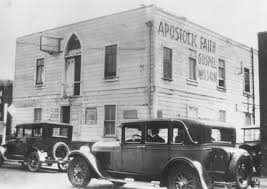
#2 Measure Everything by the Word
Do we need to study the Bible as much after receiving the Holy Ghost? Yes, if not we become fanatical or many times will be led by deceptive spirits and begin to have revelations and dreams contrary to the Word, and begin to prophesy and think ourselves some great one, bigger than some other Christians. But by reading the Bible prayerfully, waiting before God, we become just humble little children, and we never feel that we have got more than the least of God’s children.
(October 1907- January 1908)
The Corinthian church was one of Paul’s most gifted churches, and just as it is today, where a church is very gifted, the only safeguard from deceptive spirits is by rightly dividing the Word of God, to keep out of fanaticism. We must rightly divide the Scriptures and compare scripture with scripture so that there is no confusion, and no deceptive spirit or wrong teaching may creep in. (January 1908)
Without Becoming Fanatical
(January 1907)
The demonstrations are not the shouting, clapping, or jumping so often seen in the campmeetings. There is a shaking such as the early Quakers had and which the old Methodists called the “jerks.” It is while under the power of the Spirit you see the hands raised and hear speaking in tongues. While one sings a song learned from heaven with a shining face, the tears will trickle down other faces. (October 1906)
There is no pope, Doweism, or Sanfordism, but we are all little children knowing only Jesus and Him crucified. This work is carried on by the people of Los Angeles that God has united by the precious blood of our Lord Jesus Christ and the power of the Holy Spirit. (December 1906)
(Note from E. Hyatt: The references to “Doweism” and “Sanfordism” pertain to John Alexander Dowie and Frank Sanford, two of the most famous, charismatic ministers of the day who projected themselves as special end-time apostles and prophets)
#6 Realize that You Can Receive Directly from God
#7 Equality of Women with Men
in the New Era of the Spirit
4/19/2010
HOW THE COMING RESTORATION OF THE 8-FOLD MINISTRY WILL USHER THE CHURCH INTO A NEW ERA OF POWER
And God has appointed these in the Church: first apostles, second prophets, third teachers, after that miracles, then gifts of healings, helps, administrations, varieties of tongues (1 Cor. 12:28).

Like the Pharisees of Jesus’ day, many will reject the revelation truth of the 8-Fold Ministry in order to cling to their old, traditional 5-fold ministry. But for those who are willing to embrace this final work of restoration, they will experience a new and unprecedented release of God’s glory and power in their lives.
In this article I will share 4 compelling reasons why the 8-Fold Ministry should be recognized and implemented in the Church today. The reasons are: (1) God’s Prophetic Timetable indicates that 2010 is the year the restoration of this ministry will begin; (2) The prophetic significance of 8 is far superior to that of 5; (3) There is obviously more power generated by an 8-Fold Ministry than by a 5-fold ministry; and (4) There is a good chance that Paul knew nothing about a 5-fold ministry. I will also discuss the unique characteristics of the 8-Fold Ministry.
God’s Prophetic Timetable
Nonetheless, there is much more prophetic significance to the number 8. Eight is the number of “new beginnings.” Jesus arose on the 1st day of the week, which is the 8th day. I have heard some talk about the Church being in the 3rd day. They are obviously lagging behind. This is the time of the 8th day Church--the Church of new beginnings. We recently entered a “new century” and a “new millennium.” Only the 8-Fold Ministry, the ministry of “new beginnings” can lead us into the “new thing” that God has for us in this new century.
The 8-Fold Ministry Will Generate More Power
The 5-Fold Ministry May Not Have Been Paul’s Idea.
There is a good chance that Paul never wrote about the 5-fold ministry, but that someone using his name came up with the idea. For example, Paul was very close to the believers in Ephesus, having founded the church there and many or most of them being his converts. But none of them are ever mentioned in this very generic letter to the church at Ephesus.
Just look at Acts 20:36-38 where Paul is about to depart from a meeting with the elders of the church at Ephesus. As he makes preparations to leave, they all start crying and hugging and kissing him. What a sight! That Paul would write a letter to these same people and never mention any of them is kind of far-fetched, and has led some scholars to conclude that Paul didn’t write this letter.
So, right up front, there is a question whether Paul himself ever knew of a 5-fold ministry. On the other hand, nobody questions that Paul wrote 1 Corinthians 12:28. So, we are on much safer, Biblical ground if we let go of the 5-fold ministry and go with the 8-Fold Ministry.
In his 8-Fold Ministry list, Paul lists the apostle first. We should not make too much of this since in 1 Cor.4:9 he thinks God has put the apostles last and says they have been made as the scum of the earth. And in 1 Cor. 13:13 Paul lists faith, hope and love, these three, and then turns around says that love, which he listed last, is the greatest of the three. So, it is not always that easy to tell what Paul thinks about something by the lists he makes. Sometimes the very thing he esteems the most, he puts at the end of the list; and the thing he thinks least of, he puts at the top of the list. And sometimes he puts something on one list and then leaves it off another list.
For example, in the 8-Fold Ministry there is no mention of a pastor or evangelist. Paul obviously did not see these as being important or he would have listed them here. This is confirmed by the fact that in all his letters to churches, Paul never addresses a pastor or evangelist, or even refers to one. In a personal letter to Timothy, he tells him to do the work of an evangelist, but that is about it in regards to pastors and evangelists. This is because the 8-Fold Ministry brings the Church into a place of maturity where these ministries are no longer necessary.
One 8-Fold Ministry gift that is desperately needed today is that of “steering.” The NKJV calls it administrations. The Greek word is kuberneseis and it originally referred to a steersman who guided a ship. In his Greek-English Interlinear, Alfred Marshall translates the word as "governings" and it obviously refers to steering, guiding and giving direction. This gift is greatly needed to steer the other ministry gifts in the proper direction.
Many thought that with the recent restoration of apostles and prophets everything would be fine. Instead, things have gotten worse because the new apostles and prophets have had no one to steer them in the right direction. As we see a restoration of the kuberneseis, and the other ministry gifts becoming aligned with it, we will see a release of power in the Church unknown since the 1st century.
To get the restoration of this gift moving, I am considering calling myself “Steersman Eddie Hyatt,” or maybe “Governor Eddie Hyatt.” But since others will also be using this as a title once the restoration gets under way, I will probably use “Senior Steersman” or maybe “Presiding Steersman.” I would use the Greek word, but I don’t think “Kuberneseis Eddie Hyatt” sounds impressive enough--and that’s what it’s all about, isn’t it?
If you feel challenged in accepting my argument for the 8-Fold Ministry, don’t feel badly. I have the same problem with much teaching that is being propagated today in charismatic circles. Nonetheless, I think I have presented a pretty valid argument. Maybe there is something to this 8-Fold Ministry after all. LOL
This article is a satire. I wrote it using the same sort of erroneous methods that so many in charismatic/prophetic circles are using today. It is supposed to be funny and at the same time communicate a very serious message. The erroneous methods and ungodly mindset it addresses are:
4/07/2010
2000 YEARS OF CHARISMATIC REVIVAL, WHERE ARE WE TODAY?
4/03/2010
THE POWER OF HIS RESURRECTION
The Christian belief in the physical resurrection of Jesus Christ is not blind faith. In fact, there is more empirical evidence for the resurrection of Jesus than for any other event in ancient history. This is because there were numerous eyewitnesses who saw Him, talked with Him and ate with Him both before and after His death and resurrection. The first person to whom He appeared after His resurrection was Mary Magdalene, but then to the Twelve, to others and, on one occasion, to over 500 at one time of whom, according to Paul, most were still alive at the time of his writing his 1st letter to the Corinthians (I Cor. 15:6). The testimonies of these primary, first-hand witnesses are recorded in the 4 gospels of Matthew, Mark, Luke and John.
Not a Myth
Some, of course, refuse to accept the historical facts and claim that these stories are myths fabricated by followers of Jesus who wanted to deify Him. If this were the case, then those who created these myths were literary geniuses beyond anything we can imagine, for they created a person and a narrative that changed the course of human history and continues to move millions to forsake everything to follow this so-called mythological figure they created.
This reminds me of C.S. Lewis, an agnostic professor of Renaissance Literature at Oxford University, who exposed the shallow claims concerning the mythological character of the New Testament. Lewis was an expert in mythological literature and he tells of his astonishment the first time he read the gospels. His surprised response was, “This is not myth!” Lewis, of course, became a believer and an astute apologist for Christianity. It was at this time that higher criticism was being popularized in seminaries in Germany and certain theologians, such as Rudolph Bultman, were claiming that the New Testament accounts of Jesus, His miracles and His resurrection were myths created by His followers. Lewis replied, “I would like to know how many myths these people have read!” Lewis went on to explain that he had been a long-time professor and critic of mythological literature and knew how a myth sounded and felt, “And the gospel story is not myth!”
Ours is Not a Blind Faith
Yes, the evidence is there for those who are willing lay aside their prejudices and open themselves to truth and the Holy Spirit. This evidence includes, not only the eyewitness accounts, but also consideration of questions such as how the earliest disciples of Jesus were suddenly transformed from cowering individuals to bold witnesses willing to lay down their lives for their testimony of Christ and His resurrection? And why didn’t the Jewish and Roman leaders in Jerusalem, who tried to suppress the new Jesus movement, produce His body, display it publicly and, thereby, put an end to the preaching about the resurrection of Jesus? Many skeptics have been convinced of the resurrection of Jesus Christ by being willingly to lay aside their prejudices and honestly examine this sort of evidence.
A Harvard Law Professor is Convinced
For example, Dr. Simon Greenleaf (1783-1853) was the Royal Professor of Law at Harvard University and one of the principle founders of the Harvard Law School. He authored the famous three-volume work, A Treatise on the Law of Evidence, which is still considered one of the greatest single authorities on judicial legal procedure. Greenleaf originally set out to disprove the biblical testimony concerning the resurrection of Jesus Christ, believing that a careful examination of the internal witness of the Gospels would reveal the myths at the heart of Christianity. Instead, this legal scholar came to the conclusion that the witnesses were reliable, and that the resurrection did in fact happen. As a result he became a believer and wrote a book entitled, An Examination of the Testimony of the Four Evangelists by the Rules of Evidence Administered in the Courts of Justice. Greenleaf concluded that, according to the jurisdiction of legal evidence, the resurrection of Jesus Christ is the best-supported event in all of ancient history.
A British Lawyer is Convinced
A brilliant young British lawyer, Frank Morrison, decided that he would write a book showing that, based on the testimony of the eyewitnesses, Jesus Christ could not have risen from the dead. Unfamiliar with the earlier work of Greenleaf, Morrison’s plan was to examine and compare the testimonies of Matthew, Mark, Luke and John in the same way he would examine and cross-examine the testimonies of witnesses in a court of law. He felt confident that by doing so he would be able to show that their testimonies could not be corroborated. His book was never written for in the process of examining the eyewitness accounts of the resurrection and the questions raised by such an examination, he too became convinced that Jesus did, indeed, rise from the dead. Instead of a book disproving the resurrection he wrote a book entitled, Who Moved the Stone?, demonstrating, from a lawyer’s perspective, convincing proof that Jesus did rise from the dead.
The Foundation of Our Faith
The resurrection of Jesus is the foundation of our faith. If He did not rise from the dead, then His birth, His life and even His miracles are void of meaning. However, He did rise from the dead just as He predicted, giving meaning to all of life. His resurrection is the guarantee that everything else He promised, such as eternal life and His personal return, will also be fulfilled.
The Same Power that Raised Jesus
From the Dead is at Work in the Believer
According to Paul, the same power that raised Jesus from the dead is now at work in the believer. He clearly spells this out in Ephesians 1:15-23 where He says that the same power that broke the power of sin, Satan and death on that first resurrection morning is the same power at work in you and me. Paul says that this resurrection power, not only brought Jesus out of the tomb, but raised Him to the pinnacle of the universe far above all principality and power and might and dominion and every name that is named both in this world and that which is to come. In 1:19 Paul makes the point that this same power is in us by using the Greek preposition eis, which the NKJV translates as “toward” and the NIV as “in.” It literally means “into.” In other words, that same resurrection power that raised Jesus from the dead and seated Him at the pinnacle of the universe (the right hand of God) is now directed “into” us.
You see, there was a great cosmic shift in the spiritual realm when Jesus was raised from the dead. Satan was absolutely defeated. Sad to day, many Christians are still relating to the devil from an Old Testament perspective, and even formulating concepts of spiritual warfare that are based on the Old Testament. Don’t let anyone tell you that you do not have authority over Satan and all demonic forces!! This also means that you do not have to run here and there looking for an impartation from a preacher, a revival, a relic or a shrine. You already have something in you that is far more wonderful—the resurrection power of Jesus Christ. Knowing this is a key to victory over the world the flesh and devil now, in this life.
The Resurrection is Personified in Jesus
In Jesus, the resurrection became personified. When Jesus discussed with Mary and Martha the death of their brother Lazarus, He made the statement, I Am the resurrection and the Life (Jn. 11:25). During one of the darkest periods of my life when it seemed that a vision God had given me had died, I heard Him say to me, “Don’t be afraid of death, because I Am the Resurrection.”
At this time of the year—and all during the year—let’s remember that the resurrection is a reality and is a person—Jesus Christ—Who is living in you. Yes, at some future point in time He will raise from the dead all those who have trusted in Him. However, His resurrection power is at work in us now and will, through the Holy Spirit, resurrect hopes and dreams and give meaning to all areas of our lives. Rom. 5:10 says, For if when we were enemies we were reconciled to God through the death of His Son, much more, having been reconciled, we shall be saved by His [resurrection] life.